The last few months have been filled with doctors appointments, surgeries, and tests of all kinds. It’s been a whirlwind of medical scans, hospital stays, and prescriptions to fill. And it’s all come down to this – a radioactive iodine treatment.
Radioactive iodine is used to treat thyroid cancer or hyperthyroidism because the thyroid is the only organ of the body that absorbs iodine. By introducing radioactive iodine into the body, the thyroid takes it up and those cells are then killed off. It’s very effective in clearing out any thyroid cancer cells. Here’s more information about the procedure.
Right after I had my second surgery – the one removing the remaining half of my thyroid – my surgeon told me there was a CHANCE I would have to endure a radioactive iodine treatment in the near future. Technically, it’s called a Thyroid Ablation. The goal is to kill off any remaining thyroid cells, especially if the thyroid is removed because of cancer, like mine. Well, that chance became a certainty when I met with my endocrinologist.
Due to the type of cancer cells (Hurthle cell carcinoma) they found when they took out the first half of my thyroid, the need for radioactive iodine thyroid ablation was greater than for many other cases. They needed to make sure they killed off any and all of these aggressive/sneaky cancer cells lurking in my thyroid tissue. All my remaining stray thyroid cells had to go, and the best way to do it is with radiation. Yuck.
It sounds pretty scary. Knowingly and voluntarily taking radiation into your body. Doesn’t sound safe at all, does it? But it’s better than the alternative – to allow cancer cells to remain and grow all over again. But the prospect of the procedure was unsettling, nonetheless.
When the hospital called to schedule the radioactive iodine treatment, I was told I had to be off my thyroid medication for 4 weeks prior to the radiation treatment. I was stunned. Could I survive a month without my medication? I had been told how important it was I take this medication daily. I needed to make sure I took it EVERY. SINGLE. DAY. Now you’re telling me I can’t take it for a month?! Won’t I die?!?!
Well, I didn’t die. Although, sometimes I felt like I wanted to. No, not really. I was just really tired. And had trouble sleeping. But, fortunately for me, the side effects of not taking my thyroid meds was rather mild, according to everyone else. Maybe it was because my surgery had been so recent, and I still had some residual thyroid hormones coursing through my body from my original thyroid. Or maybe my body was just really good at holding on to those hormones from the meds I’d been taking for the past month. Whatever it was, I didn’t feel as poorly as everyone told me I would.
I was still able to function at work. Still able to do my job, and then come home and take care of the essential tasks at home. Note I said the ESSENTIAL tasks – I learned quickly I would only have the energy for the essential chores, and not to over exert myself and do too much.
But about those 4 weeks without the meds – turns out I didn’t need to be off my meds at all! My doctor scheduled me for Thyrogen shots for the two days prior to the actual radioactive iodine treatment. I didn’t know what these were for until I talked to a radiology tech at the hospital a couple days before the procedure. I had come up with a couple questions so I called the hospital, and during the course of the conversation he commented it was good my doctor had scheduled me for Thyrogen shots so I wouldn’t have to be off my medication.
Wait, what?!
I didn’t have to stop taking my meds? What the … ! I told him the hospital’s scheduler had told me to stop taking my meds 4 weeks ago, and had given me a list of do’s and don’ts to prepare me for the procedure. He explained the Thyrogen injections were to allow me to stay on my meds before the procedure. It was an “either or” thing; either I was off meds for 4 weeks prior to the radioactive iodine treatment OR I took the Thyrogen shots and didn’t need to stop taking my meds. I didn’t need to do both. Now I was mad (not at him, at the scheduler) – you mean I could have been taking my medication and feeling good, and instead I had been given bad info and suffered through a month of fatigue and generally feeling crappy?!?!
Regardless, I followed through on the Thyrogen shots as well – my TSH levels weren’t as high as expected, so they decided to give me the shots anyway. Since I had been off meds for 4 weeks they expected my TSH (Thyroid Stimulating Hormone) levels to be higher, but for some reason they weren’t. So, to be on the safe side, they gave me the injections anyway.
Then the big day arrives. Monday morning I present myself at the hospital, and check in at Radiology. I am actually going to the Nuclear Medicine department, but you check in at Radiology because that doesn’t sound as scary. I follow the nurse through the big double doors when my name is called, and we walk down the hallway past Radiology. And we keep walking. And walking. Because they keep the Nuclear Medicine department tucked way in the back of the hospital, I guess.
Back to the far corner of the hospital we trek. This is where my radioactive iodine treatment saga will being. I am told to sit in a little ante room outside the lab and wait for another nurse to bring me some paperwork and go over the procedure with me. I picture all the folks on the other side of the door walking around in haz mat suits and respirators. Pretty soon a nurse comes in and tells me what to expect from my stay. How the radioactive iodine will be administered (pill), and what will happen after that (total isolation for at least 2 days). Then she has forms for me to sign. Of course – there are always forms to be signed. Then she tells me to (again) wait and the doctor will be by soon to answer any more questions.
After awhile the doctor shows up. This was the only time I will every actually see the doctor whose care I am under. He’s pretty cool about the whole thing. Whereas everyone else is kinda intense about the procedure, he is absolutely laid back. I start to relax a bit. By this time the treatment has been explained to me so many times I didn’t have any questions, so its a short meeting with the doc. Then I am told to wait in a small waiting room in the back corner, and someone will be down to take me up to my room. No one else enters the waiting room the entire time I’m there.
You have to be taken to your room in a wheelchair – hospital rules. I tell the guy with the wheelchair I feel silly being taken upstairs in a wheelchair – I can walk just fine. He says I’ve got to go in a wheelchair. Oh well.
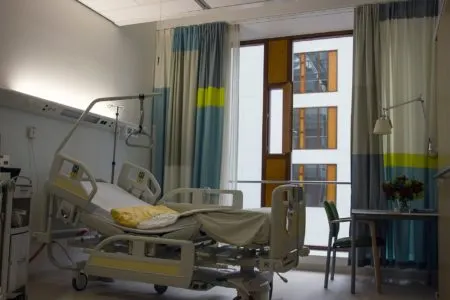
We get to my room, and I’m a little surprised. It’s a regular hospital room. I guess I was expecting it to be some sort of sparse, stripped down room that could withstand a nuclear blast. Almost like a nuclear fallout shelter – something in keeping with the whole radioactive “theme.” But it looks just like any other hospital room I’ve ever been in.
Except for the paper on the floor. And on the counters. And the saran wrap on the walls.
Yeah, there’s saran wrap on the light switches. On the phone. On the TV remote. Anywhere a radioactive patient like myself might happen to touch. Saran wrap on the toilet seat and grab bars in the bathroom. Surgical gloves over the doorknobs and handles, taped in place. Paper on the counter around the sink. And a paper walkway from the door to the bed, around the bed, and leading to the bathroom. Gives new meaning to the phrase “paper trail.”
I am given a list of do’s and don’ts for my stay. Flush the toilet 3 times after using it. Stay on the paper when I am walking in the room. Don’t stand near the door or in the doorway to the room. Rinse the sink 3 times after brushing my teeth or washing my hands. Don’t touch any surface that isn’t covered in paper or saran wrap.
I can’t take any items into the room I want to leave with. No personal items, no cell phone or laptop, tablet, or electronics of any kind. Anything brought into the room must stay in the room, be quarantined for 3 months, then destroyed. They told me about this earlier, so I’m prepared. There’s a phone in the room I can use to call people, so I’ve brought with me a list of phone numbers. My mom has given me a couple books to read that she doesn’t want back, so I bring those. Everything else will be placed in my bag and locked up in the closet.
I change out of my clothes and put on the hospital gown and socks waiting for me on the bed, and put my bag in the closet. Then I sit on the edge of the bed and wait.
Soon a tech from Nuclear Medicine knocks on the door. He’s got a cart with him, filled with all types of equipment and cases. One of these cases he places on the ground in the doorway. He puts on large gloves – they look like asbestos-lined oven mitts – and carefully opens the top of the black case. There, surrounded by foam padding, is a large, capsule-shaped container. He carefully removes the container, careful not to jostle it. It’s like a scene from every nuclear holocaust movie you’ve ever seen. He slowly opens the top of the capsule and takes out a small pill, placing it in a small plastic med cup. Suddenly he’s very nonchalant, and hands it to me to swallow. “Here you go,” he says. After all that build up, and then he acts like he’s giving me a Tylenol.
I look at the pill in the cup for a moment. I have a brief moment of uncertainty. This is radioactive. I’m going to purposefully ingest it. I take a deep breath, then let it out. Let’s get this over with. I toss the pill back and follow it with the cup of water he hands me. It’s done. We’re doing this.
I pause and take stock of how I feel. No nuclear explosion happening in my stomach. No glowing light emanating from me. I feel the same as before. No hot flashes, no Hulk-like changes, nothing different going on. I’m not sure what I expected, but I feel the same.
I relax a bit more. Now to wait this out, and then go home.
The nuclear med tech has to take an initial reading of my radiation level. He has me sit on the edge of the bed, measures 3 feet from me and then marks it on the paper. He then puts his yardstick on that mark and places the measuring device, which looks like a small-ish black box, on top of the yardstick. I sit very still. He says the initial measurement is 23. I don’t know what units – 23 what? Volts, ohms, grams – what is radiation measured in? I’ve forgotten my high school science lessons about radiation. Whatever units it’s called, its 23 right now. He tells me it needs to be under 7 for me to go home. That’s my goal: <7
The way to lower the reading? Pee and poop. Simple and direct. The more you pee (and poop), the faster you get out of the hospital and go home. Your body gets rid of the radiation through urine, feces, saliva and sweat (pretty much in that order). But mainly through your urine. I immediately ask for a large container of water. Thank goodness the hospital has large 32-ounce water cup/mugs. I love those things! I already have two at home from previous surgeries. They are super handy for keeping you hydrated. Fill it up!
Now that I’ve taken my pill, and I have my water handy, I’m all alone. Nurses will only come to check on me if I call them. Any food I order from food service will arrive and be handed to me at the door. No one will cross the threshold of my room (except my nuclear med tech friend when he shows up tomorrow morning for another reading) while I am at the hospital. I have a big sign on my door warning everyone I am radioactive and they can’t enter my room.
At first it’s quiet and restful. I am totally by myself, and the peace and quiet is nice. I turn on the TV and find a Criminal Minds marathon. I adjust the bed to my satisfaction (yes, the controls are covered in saran wrap) and settle in for the afternoon. It’s noon, and I have been told I can order something to eat in an hour.
At 1 pm I take a break from Reed, Prentiss, Garcia, and company to order lunch. I want something healthy that will … ahem … move along the bowels … so I order a Harvest Chicken Salad. Full of greens, grilled chicken, walnuts, dried cranberries, etc. Creamy Herb dressing to go with it. It arrives a short time later, and is possibly the biggest salad I’ve ever seen. I finish it off (barely) while I watch another episode of Criminal Minds.
After that, time seems to slow down. I watch TV, fall asleep, turn off the TV and read, nap, watch TV again, etc. Day 1 is somewhat relaxing, and relatively peaceful. It’s nice to have nowhere to go, no responsibilities, no chores, no work, nothing to do except sleep and read and watch TV. I am feeling no side effects from the radiation. Just very frequent trips to the bathroom due to all the water I’m drinking.
I sleep fairly well that night. Much different from the nights spent in the hospital following my surgeries, where RNs are coming in every 1-2 hours to check vitals. This time no one enters my room, and I can snooze for long stretches of time with no interruption. But I am feeling a little shunned. I know they can’t be in my room, but it would be nice for a nurse to come to the door and inquire about me once in awhile.
Day 2 brings more of the same. More water, more isolation. My nuclear med tech arrives at 11 am to take another reading. Now my level is down to just under 11. He says he’ll be back mid-afternoon to check again – if my radiation level keeps dropping like it has been, I might be released to go home later today! I begin to chug water in earnest. I can see the finish line!
I continue to rest, but am bored with TV now. I don’t watch much TV at home, so I have pretty much overdosed on Day 1. I stick to reading most of the time today, and finish off one of the books Mom gave me. The nuclear med tech (a different one) shows up about 2 pm to check my level. She says my level is still too high – it’s just between 8 and 9! Wait, I want MY med tech (notice how he’s now MY med tech). She obviously did it wrong. I demand a recount!
Oh well, another night in the hospital. I figured it would be a 2-day stay anyway, so this isn’t changing what I’d already planned on. Just disappointing to have false hope put out there, then taken away. So I settle in for a second night. By now my throat is hoarse and sore. That’s one of the side effects they told me about. When the radioactive iodine treatment targets the thyroid tissue, your throat can get really tender. The pain in my neck doesn’t bother me nearly as much as how my voice sounds. I sound like a 70 year old, 3-pack-a-day smoker! When I talk to my daughters and mom on the phone they hardly understand me. I sound nothing like myself anymore!
The next morning I am very hopeful of being discharged. It’s Wednesday, and my levels HAVE to be low enough by now. I wait impatiently for the med tech to show up. Didn’t they say yesterday they would be here FIRST THING in the morning?! 8 am comes and goes, then 9 am. I am almost ready to call a nurse and ask her to call nuclear medicine for me when there’s a knock at the door. It’s the med tech – not MINE but the other one. Oh well. She takes the reading and announces I’m at 4.3! Happy dance!
I can go home now, and she promises to have the doctor sign off ASAP. So I begin the wait for the discharge papers to be signed. And I wait. And wait. Does it really take this long to get paperwork done? Or does it just seem like it’s taking forever because I’m anxious to get home?
FINALLY, the RN knocks on my door and says I’m ready to be released. I change out of the hospital gown and into my regular clothes. I am more than ready to get home and have a shower. I have not had “shower privileges” while I have been in the hospital, and I feel rather gross. My hair appears stringy to me – I usually wash it every other day, and am acutely aware of how long it’s been since I washed it Sunday night.
Final discharge instructions are given; no sleeping in the same room with children for 2 weeks (no worries there, my daughter has her own room), keep 6 feet away from family members for the next 2 days, no sharing of food or utensils, etc. Precautions to follow for the next 2-3 days, but nothing too strenuous or taxing. We’ve talked about this stuff already, Rachel and I. She knows I will have to keep my distance from her for a few days, just to be safe.
I thank my nurse, and start walking for the car. The sun is shining and I’m now headed home!
The biggest change in the time since the radioactive iodine treatment has been with my taste buds. Food tastes different than it used to. Not all food, but certainly salty foods, and some spicy foods. Sweet foods still taste the same, but other foods I have noticed taste different. I can tell I’ve lost some taste buds. I was told this may be temporary or permanent; sometimes the taste buds come back, sometimes they don’t. I hope they come back. Food isn’t as much fun anymore. I miss a lot of the flavors; it tastes much more bland now than it used to. But if that’s the only side effect, I’ll take it. It’s better than having to worry about cancer cells still floating around in my body.
Speaking of … I had a whole-body, meta scan a week after the radioactive iodine treatment and the results came back “unremarkable.” I find this funny, that they use the term “unremarkable.” Anyway, I guess that’s doctor-speak for WE DIDN’T FIND ANY CANCER. The scan didn’t show any stray cancer cells floating around in my body! Thank you, radioactive iodine treatment!
Now we wait and see what happens. I will need to have follow up appointments with my endocrinologist and more scans down the road to make sure no cancer cells show up again. It’s going to be a 5-year process, as I understand. But it’s starting off well, and I pray it continues to go well over the next several years. I’m back on my thyroid meds again, and gaining more energy and strength. I know it’s a long haul, but here’s to being on the road to recovery from thyroid cancer!
- Worthy or Worthless – Single Mom Struggles
- How To Build A Single Mom Resource Group
- 3 Keys To Teach Kids About Debt
- Criticall Exam Tips – How To Pass The Test
- Tithing As A Widow – Can You Afford It?
- Anxiety – Don’t Let It Control You!
- How To Save Money – Automate Your Savings!
- Cut Grocery Spending Down To Size
- How To Create A 72-Hour Bag
- Laundry Room Organization Hacks and Tips
- 7 Tips To Beat Seasonal Depression
- Heart Disease – Healthy Changes To Lower Your Risk
- Brown Sugar Pound Cake Recipe
- How God Blesses Broken Hearts – Dealing With Grief
Please share this article if you found it helpful. I’d love for other folks to be able to find it. Thanks!

Joan Merrell is a solo mom to two daughters, a widow, and a security technician at Oregon State Hospital. Oregon native, farm girl and 4H leader, maker of homemade bread and chocolate chip cookies, she balances (more or less) full-time work with caring for a home filled with a teenage daughter, 2 entitled cats, and a hyper German Shepherd. She enjoys gardening and hiking, reading Ted Dekker and Frank Peretti novels, and searches for a few spare minutes to communicate with her grown daughter and son-in-law on her Marco Polo app. Find out more about Joan here.
Very informative. Thank you for sharing your experience. God bless you
Thank you, Sarah. I found that, when I had my radioactive treatment, there wasn’t a whole lot of information out there to tell me what to expect. So I thought I’d share my experience, hoping that it would help someone else facing it. Thanks for taking the time to read the post, and for commenting. Have a great weekend!